Phone: 470-219-4231
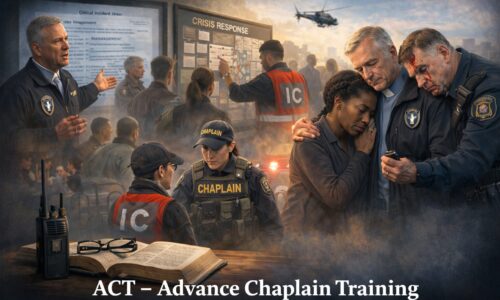
Advance Chaplain Training (ACT) is a required upper-level formation course designed to refine leadership capacity and elevate ministerial competence within complex institutional environments. Building upon foundational preparation, this course develops advanced theological integration, executive-level pastoral leadership, and organizational influence. Students examine servant leadership models, command-structure navigation, policy awareness, and ethical authority within multi-layered systems such as healthcare institutions, law enforcement agencies, fire departments, correctional facilities, and community response networks. Emphasis is placed on strategic thinking, emotional regulation under pressure, and representing spiritual care with professionalism and doctrinal clarity.
A central component of CAT is advanced trauma care and crisis ministry dynamics. Participants receive expanded instruction in psychological first aid principles, cumulative stress exposure, moral injury, critical incident stress management (CISM) collaboration, suicide intervention awareness, grief complexity, and long-term spiritual stabilization. Training addresses the neurobiological impact of trauma, compassion fatigue, secondary traumatic stress, and burnout prevention for both caregivers and responders. Students learn to assess spiritual distress indicators, provide structured pastoral interventions, and coordinate appropriate referrals while maintaining confidentiality, documentation integrity, and ethical compliance within institutional protocols.
The course further strengthens competency in counseling dynamics and interagency cooperation. Chaplains are trained to function within multidisciplinary teams, communicate effectively with command staff, mental health professionals, and emergency management personnel, and operate within unified command structures during large-scale incidents. Advanced ministry skills include conflict mediation, family liaison responsibilities, death notification presence, ceremonial functions, and strategic community engagement. Upon completion, graduates demonstrate mature pastoral judgment, operational readiness, and leadership credibility—equipping them to serve not merely as supportive presence, but as trusted spiritual advisors within high-responsibility environments.
Instructor


Leave a Reply